
Fear - Hope

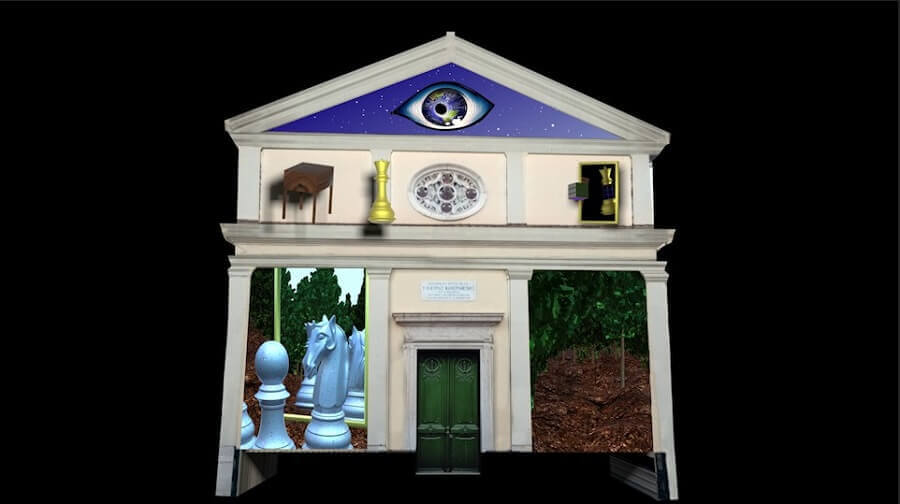
Presentation of 3d projection mapping, on Church of Panagia ton Xenon, Kyra - Faneromeni (Old Town, Corfu, Greece), October 2, 2020 at 10:00.
In the dissertation, following the strategy of deliberate ambiguity and crossing different eras, we go through a path of images and information, which express hope and fear in various fields and they characterize every culture and every society.
At the same time, moving from formalism to realism, it emerges that the Aristotelian definition of the representational unity of space-time-action is no longer valid in art. Undoubtedly, the formalist movement has shown that planes are understood not only as sequences of logical units, but also as theoretical or ideological conceptions, where their connection is not legitimized on the basis of the principle of space-time unit, but by some abstract theoretical model, such as is the model of metaphor, the path through contradictions, symbolism and anything else that enhances the removal of the theoretical model. But also internal realism, which is not a theory of truth, highlights the convergence of two seemingly incompatible ideas.
Chrysavgi Outsika, Dimitris Dandalos
Related Works
An experimental workshop was realized at the Corfu Archaeological Museum, on May 2019. The workshop was designed within the frames of interdisciplinary learning and participatory art, based on Maker culture and STEAM education, willing to highlight the importance of arts and technology in learning. The participants, children and adolescents 11 to 15 years old, were initially guided to an important archaic find at the Archaeological museum of Corfu, a pediment depicting ancient Greek goddess Artemis-Gorgo, and got acquainted with the myth surrounding it. In two groups the participants made
1. electronic circuits which produced sounds via photo resistor and conductive paint and
2. conductive drawings inspired by the archaic pediment imagery.
The two groups combined their work to create interactive installations were circuits and sensors were used to “read” the tonal variations and line elements of the pencil drawings. Documentation indicates the childrens’ immersion into the experience.
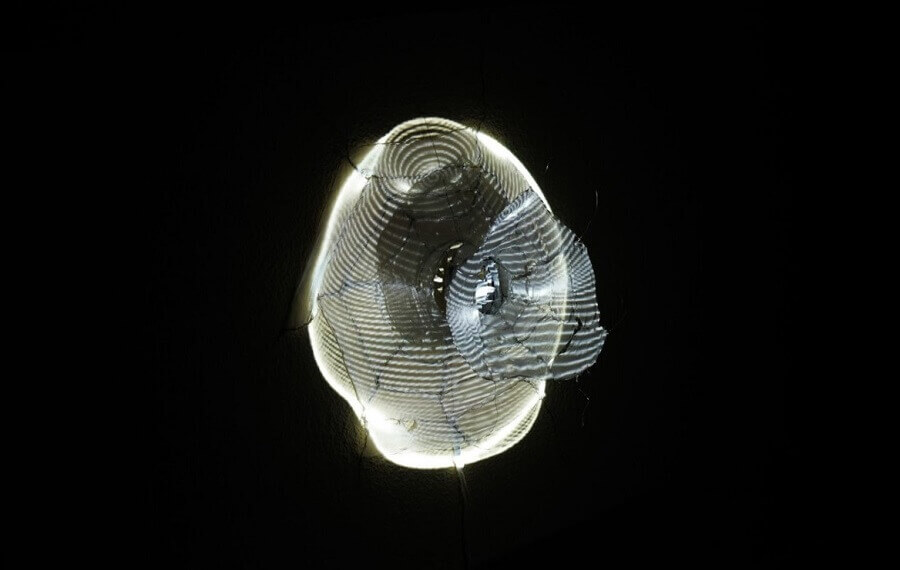
Where do memories go when they are lost? Are they still where we left them, if we don’t recall them? In this room, as private and irrevocable as our memory, objects animate a series of scenarios. A memory floods the room, another struggles to disclose itself, another one leaks back and forth in time. The idea of the ‘other’ hovers between what has already passed and what is reminisced every time. We never recollect events and spaces as such. We always enliven recollections in our own way. Through constant evocations that seek to perpetuate the existence of the ‘room’, memories converse with space and time, as well as with a part of ourselves. Either as past, forgetfulness or loss, they always contain something that is already gone.
The current project is a digital, interactive, audiovisual application that can be used either as a virtual installation accompanied by a simultaneous projection of its content in the physical space or be distributed as an executable digital medium on any computer, compatible with its technical specifications. It examines the flow of information, its creation, collection, storage, interpretation and utilization through perceptual mechanisms that mutate -enhance or degrade- with the available tools of digital reality and its transformation from a sequence of serial, adjacent and referential values to one unified context, what is usually interpreted as meaning or significance. The participants of this reality are called upon to engage at the degree of signification that expresses them better, ranging from a purely perceptual and empirical viewing to a frantic clarification of everything included.
As Vincent van Gogh's "Starry Night" is one of my favorite paintings, I created an acoustic composition with the main goal of creating an atmosphere with a freer and more abstract approach. The small touches, the colors, the swirling flow, the natural landscape of the painting and the psychosynthesis of the artist are captured. The piece in combination with two images consists of three parts. In the first part, the night landscape is presented, in the second the intense emotions of the artist and in the third the nature with its power that calms the human soul.
A professional electrician works in the villa of the rich professional actor. The electrician is also an amateur theater actor. The love of the amateur actor seems to be greater than the famous actor. The famous actor tries to make money but the amateur tries to do what he loves.
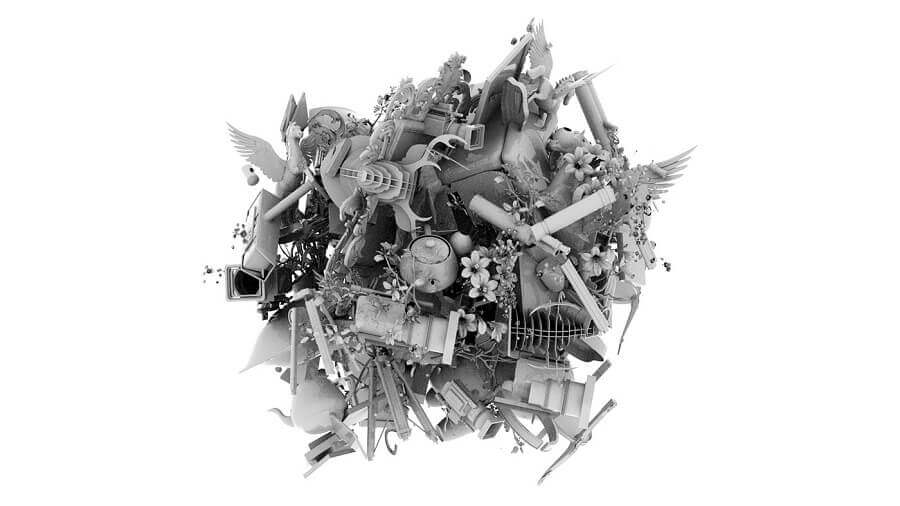
The project composes a series of random artifacts relating to art and design history, used either ας decorative or utilitarian artifacts, turning them into a non-definitive object [bouquet] floating in space.
EX-SITU[existing situations] is an interactive installation that incorporates a computer, sound, and lighting technologies in which users/ viewers take part in the destruction of the painting by stepping on it. At the same time, a motion tracking system marks visitors and a light spot tracks them.
The content of EX SITU calls for awareness of social indifference, self-promotion, and their impact on society. The structure of EX SITU is intentionally ambiguous, revealing the obsession/fascination for the protection of material in contrast with the empathy for other people.
The interactive installation underlines the responsibility of individuals in society. The theoretical part analyses the Destruction in Art Symposium in 1966 and The bystander effect, or bystander apathy, in which individuals are less likely to offer help to a victim when other people are present.
The research documentary A Quest for Eternity (2020) focuses in four different elements of Angelopoulos’s style and provides new information using and analysing the data from semi-structured interviews. This research documentary is part of Dr. Iakovos Panagopoulos practice based Phd research in the University of Central Lancashire with the title: “Reshaping Contemporary Greek Cinema Through a Re-evaluation of the Historical and Political Perspective of Theo Angelopoulos's Work”(Panagopoulos, 2019).
BRAINRINTH is a multi-channel video installation. The work attempts – through technology – to approach brain-related functions of memory, drawing on material from personal experience of the body in crisis. The title BRAINRINTH –from the words Brain and Labyrinth – is a play on the intractable riddle of an archetypal Greek structure (the labyrinth) and the labyrinthine processes of the human brain. The BRAINRINTH installation seeks a poetic mapping of the human brain.
Due to the shock of trauma, our understanding of the functioning of the body, and of nature itself –which we are trying to dominate – seems desperate and full of anxiety. Taking this into account, if we adopt a position in which we keep a distance of aesthetic neutrality, perhaps this reality begins to look less frightening.
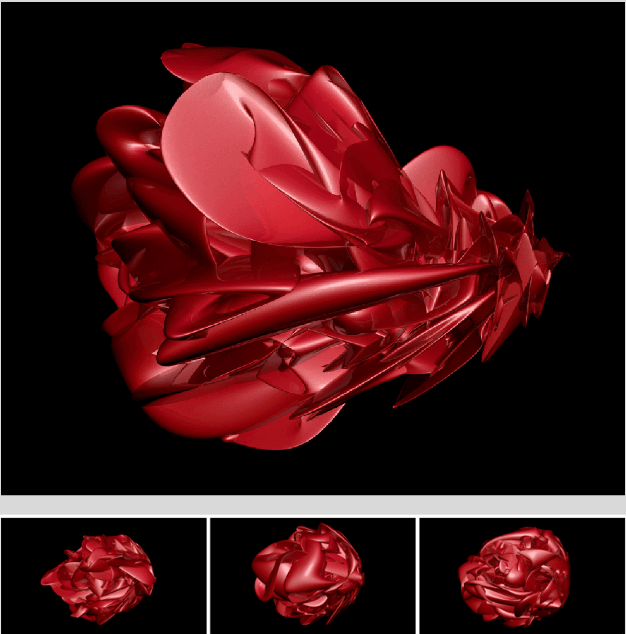
Visualisation of the sound piece: "Jozef Malovec -Orthogenesis"