
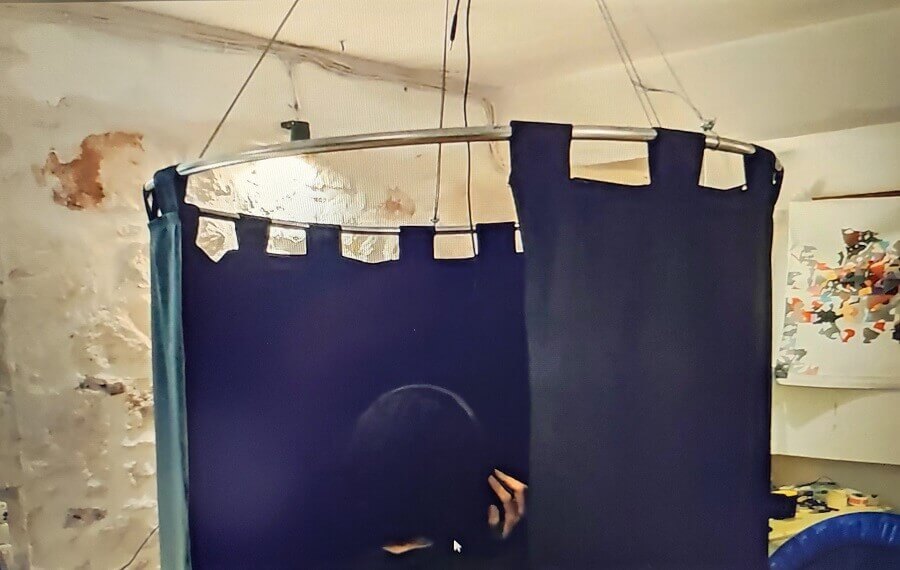
Changing room

Related Works
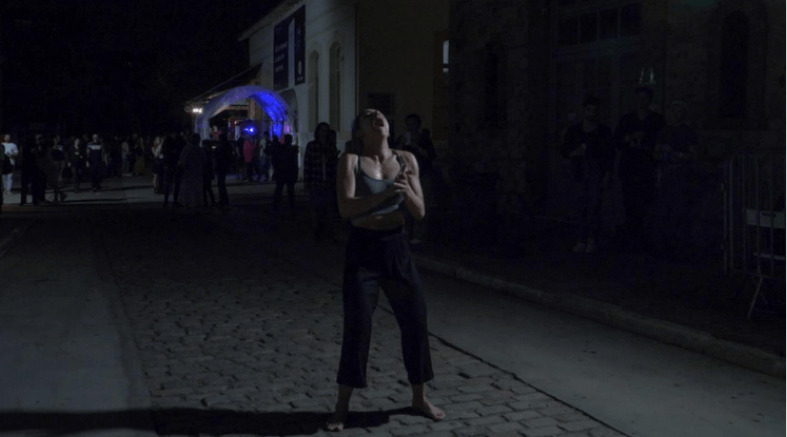
Zoe is a 25 year-old student, living in Corfu island, Greece with her only friend and roommate Anne. Waking up late an afternoon Zoe realises that her friend is missing and she goes out at night alone in search of her. The strangely empty and quiet town, a series of bizzare events and the sense that she's been followed gives her the realization that something strange is going on and her eager to find her friend grows stronger.
At that time she comes across a dark human figure that wants to capture her. Trying to escape, Zoe ends up in a white room with nothing but a mirror inside.
As she walks closer to the mirror she sees that someone is trapped inside a room. Thinking that it's her friend Anne she reaches and goes through the mirror into that other room.
As she sits down next to the other person, thinking that she is Anne, she realizes it's her own self. In a desperate and decisive moment she tries to save her double, only to realize that her double can not cross to the other side of the mirror. Realizing that there's no way out the double lets go of Zoes hand.
Zoe wakes up in her room in the morning, gets dressed and goes for a walk by the sea in the now fully alive and noisy town. As she stands and stares at the waves she meets a girl named Anne sitting nearby. After the two girls meet they sit by the sea talking.
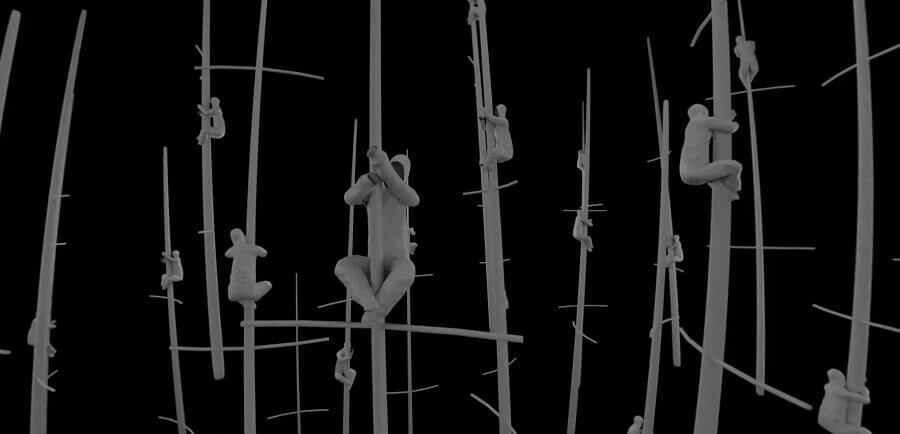
BRAINRINTH is a multi-channel video installation. The work attempts – through technology – to approach brain-related functions of memory, drawing on material from personal experience of the body in crisis. The title BRAINRINTH –from the words Brain and Labyrinth – is a play on the intractable riddle of an archetypal Greek structure (the labyrinth) and the labyrinthine processes of the human brain. The BRAINRINTH installation seeks a poetic mapping of the human brain.
Due to the shock of trauma, our understanding of the functioning of the body, and of nature itself –which we are trying to dominate – seems desperate and full of anxiety. Taking this into account, if we adopt a position in which we keep a distance of aesthetic neutrality, perhaps this reality begins to look less frightening.
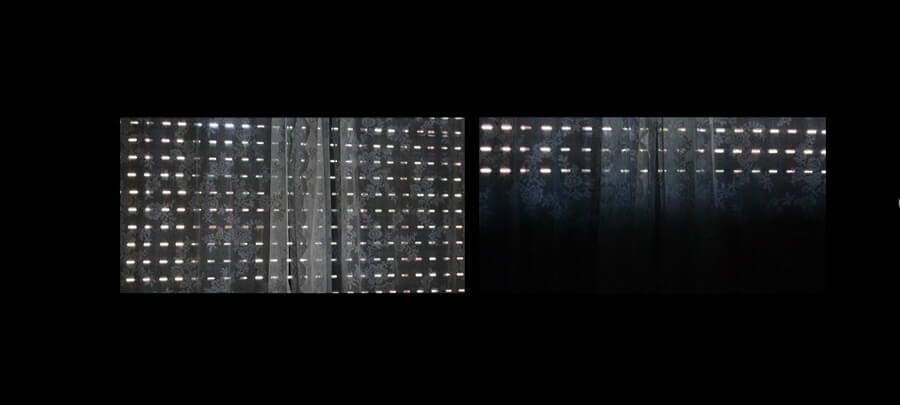
In the realm of acoustic hyper-reality we meet aural simulacra of the order of maleficence. These are signals that mask and denature a profound acoustic reality. They are referential and representational, but in a way that they dissimulate reality and become its twisted Doppelgängers. Simulacra of the order of maleficence are perversions of reality. With the sound artwork ‘Natural Perversion’ Through a set of sonic processes the artist delves into autogenerative, autopoietic, responsive and biomimetic modes of creation exploring how the original naturally produced audio signal can be transformed into a sonic caricature and depending on the way it balances between its signifier and its signified aspect, it may re-interpret naturally produced concrete audible events into a musical language which serves both the acousmatic and the non-cochlear approaches to contemporary sound art.
A documentary about Lazaretto, the desert islet near the city of Corfu that functioned for centuries as a quarantine station as well as a place of execution for political prisoners during the Greek Civil War. The identity of the place is approached through fragmentary testimonies and original sources.
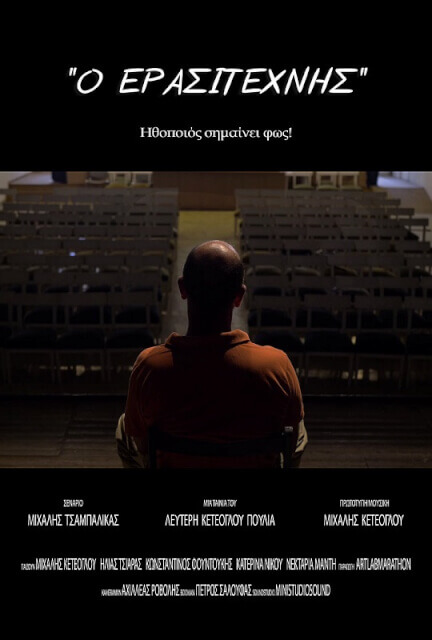
A short documentary, based on the theory of Observational Cinema. It is the portrait of the caretaker of the British Cemetery in the island of Corfu, Greece, Mr. Yorgos Psailas. The documentary deals with his daily life in the cemetery. Mr. Psailas also recounts the most important moments of his life as well as his thoughts about life and death.
This thesis is about the production, direction and animation οf a contemporary dance music video lasting four (4) minutes. Its title is "OBLIVION: Music video using the Rotoscoping technique". Its subject is the loss of a great summer love and the pain that comes when this love is over. Its goal for all of its elements be to harmoniously joined together i. e. the dance, the surroundings, the colors, the music and the animation so as to make the viewer feel nostalgic and melancholic.
Myths are living stories that grow with time, change, adapt, but continue being a source for research, inspiration and creativity. The interactive audiovisual theatrical performance INRIRI questions the adaptation of an archetypal myth at a time of many dimensions and levels with elements from physical theater and embedded interactive technology in the performing space. Parts of the story are a Caribbean myth which transforms the body, a woodpecker and some new experimental technologies. On stage two bodies try to communicate with themselves and the environment around them and to discover anew what a body can be, what the relation and connection with the other body and which are the influences of the surrounding space on them.
It’s Monday, the 13th of December 1943, the small town of Kalavryta is set on fire by the occupation army of Nazi Germany while the entire male population is being gathered on a nearby hill and shot dead. This war crime will go down in history, along with the massacre of Acqui Division, as the largest mass killing in Greece during WWII. Three men who witnessed these events as kids, locked up with the rest women, children and elderly people in Kalavryta’s primary school, recall this traumatic experience.
The project is the animation of the fairy tale "The chained elephant". "The Chained Elephant" is one of the stories of psychiatrist Jorge Bukay from his book "Let me tell you a story" which he tells to his client. It refers to a child' s question who notices that a huge circus elephant remains tied to a small stick without trying to free itself and without protesting. The circus elephant remained tied to his tiny stick because "the memory of the weakness he felt shortly after his birth is etched in his memory."